How to Choose the Best Spring Return Actuator for Your Needs?
Choosing the right spring return actuator is crucial for various applications. These actuators provide reliable and efficient control in systems requiring automatic closure. Understanding your specific needs is essential to make an informed choice.
Spring return actuators come in different types and sizes. Each serves unique purposes in industrial and commercial settings. Factors like force, speed, and environment play significant roles in your decision. Matching these characteristics with your application ensures optimal performance and longevity.
It's easy to overlook details when selecting a spring return actuator. Many users prioritize price over functionality, leading to future complications. Investing time in research will pay off when the actuator performs as expected. Reflecting on past choices can improve future selections, ensuring your system runs smoothly and efficiently.
Understanding Spring Return Actuators and Their Applications
Spring return actuators are widely used in various industries due to their reliability and efficiency. These devices operate by using a spring mechanism to return to a specific position when deactivated. Many applications, such as HVAC systems and process control, benefit from the fail-safe nature of these actuators. According to industry data, around 70% of automation systems utilize spring return actuators, highlighting their importance.
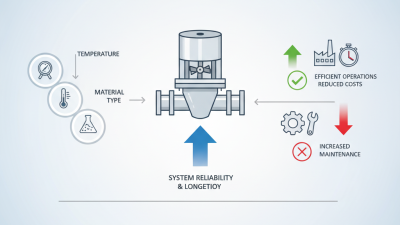
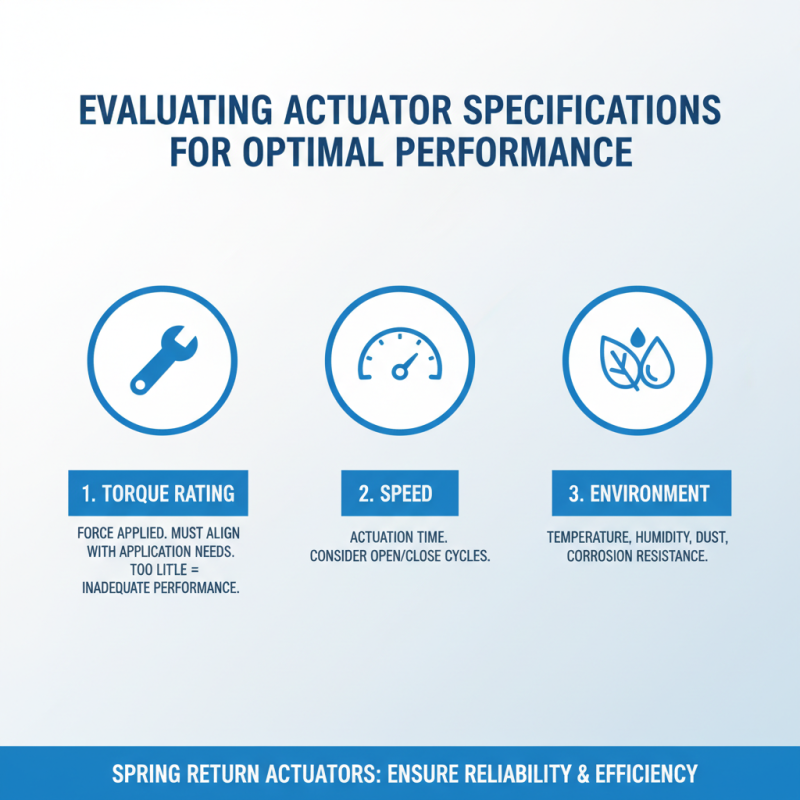
The selection of a suitable spring return actuator depends on several factors, including torque requirements, speed, and application environment. For instance, a high-torque actuator may be necessary for heavy gate operations, while a more moderate torque could suffice for lighter applications. Often, users overlook the impact of environmental conditions, which can affect actuator performance. Particularly, exposure to extreme temperatures or corrosive substances can significantly reduce lifespan or functionality.
Choosing the right actuator isn't always straightforward. Technical specifications may sometimes be confusing, leading to potential mismatches. Reports suggest that nearly 40% of actuator failures trace back to inappropriate selections. Investing time in understanding specific requirements and possible challenges can lead to better decision-making. Always remember, informed choices enhance operational efficiency and safety in any automated system.
How to Choose the Best Spring Return Actuator for Your Needs?
| Feature |
Standard Model |
Heavy-Duty Model |
Corrosive Environment Model |
| Torque Range |
20 - 150 Nm |
150 - 600 Nm |
20 - 500 Nm |
| Spring Material |
Carbon Steel |
Alloy Steel |
Stainless Steel |
| Operating Temperature |
-20°C to 70°C |
-30°C to 80°C |
-40°C to 90°C |
| Application Type |
General Industrial |
Heavy Machinery |
Chemical Processing |
| Voltage Options |
24V, 110V |
24V, 380V |
24V, 480V |
Key Factors to Consider When Choosing a Spring Return Actuator
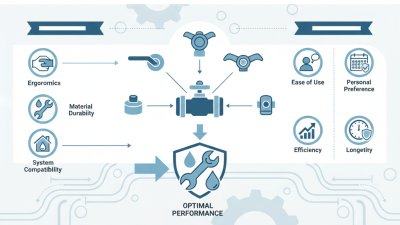
When selecting a spring return actuator, consider various factors that suit your specific needs. The actuator's size should match your equipment's dimensions. A compact model may fit tight spaces. Conversely, larger applications require more robust actuators. Review the torque requirements. Assess what force will be needed to drive the mechanism accurately.
Next, think about the environment where the actuator will operate. Will it face moisture, dust, or extreme temperatures? Select materials that can withstand these conditions for better reliability. The actuator's lifespan is also critical. Cheaper options may fail sooner, requiring replacements that hinder productivity.
Lastly, evaluate the installation process. An actuator that is difficult to mount may increase labor costs. Choose ones with flexible installation options to simplify setup. Feedback from other users can help indicate potential issues. While it’s tempting to focus solely on features, don’t overlook the importance of support and service from the supplier. Reliable customer service can save you headaches down the line, even if the actuator has some shortcomings.
Assessing Installation and Maintenance Requirements for Actuators
When selecting a spring return actuator, understanding installation and maintenance requirements is crucial. According to industry reports, nearly 70% of actuator failures stem from improper installation. An actuator must align perfectly with your system for optimal performance. Ensure that mounting brackets and electrical connections meet specifications. Inconsistent installation can lead to inefficiencies and safety concerns.
Maintenance plays an equally vital role. Regular checks can prolong the life of your actuator. Studies show that well-maintained actuators can last up to 40% longer than neglected units. It's essential to inspect seals and lubrication. Inadequate lubrication can hamper performance and cause wear and tear. Consider creating a maintenance schedule based on usage frequency.
Don’t overlook the importance of training personnel. Many operators lack the necessary skills for installation and maintenance. Training programs can significantly reduce operational errors. Industry surveys reveal that companies investing in training have reported a 25% reduction in actuator-related issues. Investing time in installation and maintenance can yield reliable and efficient actuator operation.
Comparing Top Brands and Models of Spring Return Actuators
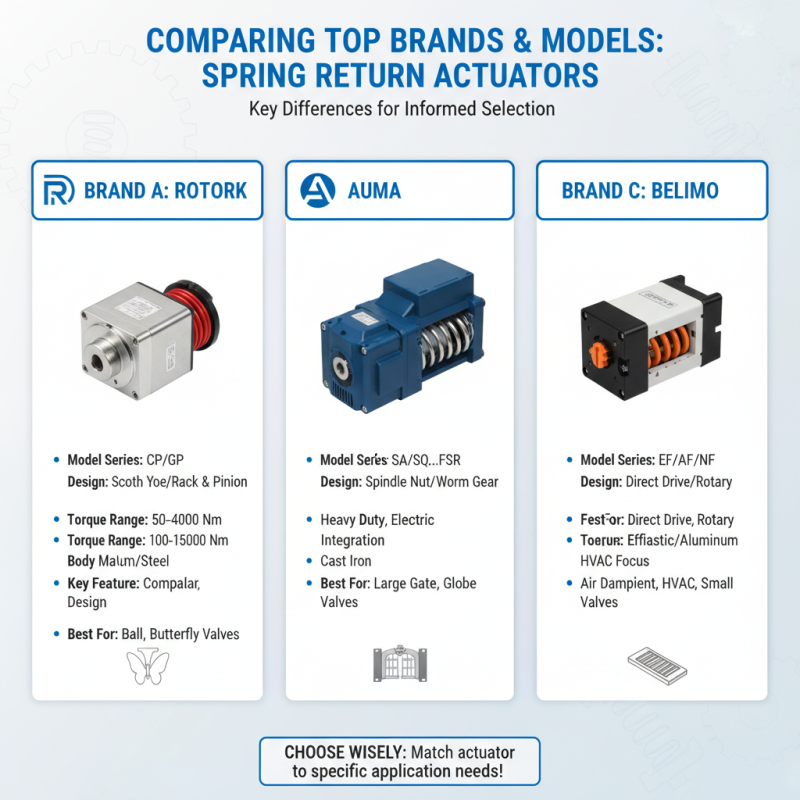
When selecting a spring return actuator, understanding different brands and models is crucial. Spring return actuators vary significantly in design and function. Each brand often introduces unique features that cater to specific applications. Exploring these variations can help you find the best fit for your needs.
Different models may excel in areas like speed, torque, and durability. Some actuators may perform exceptionally well in harsh environments. Others might be better for precision tasks. It's vital to consider your specific requirements. A model that works well for industrial use may not be ideal for smaller applications.
While many options exist, maintaining reliability is paramount. Look for products backed by extensive testing and user feedback. A thorough comparison can reveal strengths and weaknesses. Sometimes, even top-rated models might not meet your unique needs. This highlights the importance of researching thoroughly and reflecting on what truly matters for your project.