Choosing the right refrigeration system in 2026 requires more than comparing compressor horsepower or purchase prices. Buyers must match each Refrigeration Condensing Unit to the application, climate, refrigerant, load profile, and maintenance resources. A small grocery freezer may need a compact air-cooled unit, while a cold-storage facility may benefit from a water-cooled design or parallel compressor system. The correct choice begins with real operating conditions.
This guide examines common types, including scroll, reciprocating, screw, semi-hermetic, air-cooled, and water-cooled units. It considers capacity control, energy efficiency, sound levels, installation space, and service access. For example, an outdoor unit exposed to a 38°C summer ambient may lose performance if its condenser is undersized or poorly ventilated. A unit that looks efficient on paper may struggle beside a dusty loading dock.
Specifications matter.
Reliable buying decisions should use verified performance data, manufacturer documentation, warranty terms, and qualified technician feedback. Buyers should check refrigerant compatibility, voltage, oil requirements, defrost conditions, and expected operating temperatures before approval. Local climate and electrical conditions also deserve attention. They are often underestimated.
This 2026 overview is designed to support practical comparisons rather than promote one universal solution. Some recommendations may change after a site survey, and that is acceptable. Actual heat load, piping length, airflow, and service history can challenge initial assumptions. Careful selection reduces energy waste, protects stored products, and helps prevent costly interruptions throughout the equipment’s working life.
A condensing unit is a working system, not merely a compressor in a metal cabinet. The compressor raises refrigerant pressure and temperature. The condenser then rejects heat through air or water. An air-cooled unit usually simplifies installation, while a water-cooled design can perform better where water and maintenance are dependable.
The International Energy Agency reports that cooling demand could more than triple by 2050 from 2016 levels. Efficiency deserves early attention.
Compressor selection should match load variation, suction conditions, and service expectations. Scroll compressors suit many compact applications. Semi-hermetic compressors can offer practical repair access. Variable-speed compressors reduce cycling during partial loads, but their controls require careful commissioning.
A receiver stores liquid refrigerant during changing load conditions. It is useful, but not automatically necessary. Oversizing it can create avoidable cost and charge-management problems.
Controls connect these parts. Pressure switches, fan-speed control, crankcase heating, and temperature sensors protect operation. Electronic controllers can coordinate capacity and condenser airflow.
The U.S. Department of Energy’s 2023 technical assessments repeatedly identify part-load efficiency as an important factor in refrigeration performance. Field experience supports that view, although real results depend on piping, airflow, and maintenance.
A published efficiency number can mislead. Buyers should request rated conditions, sound data, service clearances, and control sequences.
Do not ignore the receiver’s liquid-level behavior during defrost or shutdown. Small details matter.
Choosing a refrigeration condensing unit in 2026 starts with its heat-rejection method. Air-cooled units use fans and ambient air. They are straightforward, widely serviceable, and suitable where water is limited. However, performance can drop during a 38°C afternoon. Coil spacing, airflow, and dust control matter greatly. Water-cooled units reject heat through a water circuit. They often maintain steadier condensing temperatures in warm spaces. Their drawbacks include pumps, water treatment, scaling, and additional maintenance.
Evaporative-cooled units combine airflow with water evaporation. This can produce lower condensing temperatures and improved efficiency in dry climates. They need reliable water quality management. Freezing conditions also require careful protection. A mistake I have seen is choosing evaporative cooling only from efficiency figures. Local humidity, water availability, noise limits, and maintenance skills can change the result. Actual refrigeration load calculations remain essential.
Tips: Measure the hottest design-day temperature, not today’s weather. Check condenser clearance with a tape measure. Ask how often coils, strainers, and spray systems need cleaning. Compare electrical demand, water use, service access, and expected operating hours. Leave room for imperfect conditions; real installations rarely stay as clean as drawings suggest.
A practical comparison of common heat-rejection options for commercial and industrial refrigeration applications
| Evaluation Dimension | Air-Cooled Condensing Unit | Water-Cooled Condensing Unit | Evaporative-Cooled Condensing Unit | Buyer Consideration |
|---|---|---|---|---|
| Heat-Rejection Method | Refrigerant heat is transferred to outdoor air through a finned condenser coil and fan airflow. | Refrigerant heat is transferred to circulating water through a heat exchanger, then rejected through a cooling tower, fluid cooler, or similar system. | Heat is rejected by spraying or distributing water over a coil while fans move air across the wetted surface; water evaporation provides additional cooling. | Select according to climate, water availability, maintenance capability, and installation constraints. |
| Typical Condensing Temperature Above Outdoor Wet-Bulb | Usually about 10–20 K above outdoor dry-bulb temperature, depending on coil sizing and airflow. | Often about 5–12 K above entering condenser-water temperature when the water circuit is properly designed. | Often about 5–12 K above outdoor wet-bulb temperature under suitable operating conditions. | Lower condensing temperature generally reduces compressor lift and improves refrigeration efficiency. |
| Performance in Hot, Dry Weather | Moderate Performance declines as outdoor dry-bulb temperature rises. | High Performance depends on the temperature and flow of the condenser-water circuit. | High Dry air improves evaporative cooling, provided water quality and supply are adequate. | Evaporative systems can offer a strong advantage in dry climates; water-cooled systems need an effective heat sink. |
| Performance in Hot, Humid Weather | Low to Moderate High outdoor dry-bulb temperatures increase condensing pressure. | High Can maintain stable operation with a properly sized cooling-water system. | Moderate High wet-bulb temperature reduces evaporative cooling potential. | For humid climates, water-cooled equipment may provide more predictable heat rejection than evaporative equipment. |
| Water Consumption | None in Normal Operation No process water is required for heat rejection. | Low to High Depends on whether the system uses a closed loop, cooling tower, or once-through arrangement. | Continuous Make-Up Required Water is lost through evaporation, drift, and blowdown. | Check water cost, drought restrictions, treatment requirements, and discharge rules before selection. |
| Energy Efficiency Potential | Moderate Often lowest system complexity, but fan power and high summer condensing temperatures can increase energy use. | High Lower condensing temperatures are possible, although pumps and cooling-tower fans consume energy. | High Evaporative heat transfer can reduce compressor lift, with additional fan and water-pump power. | Compare total system power, including compressor, condenser fans, pumps, cooling towers, and water treatment equipment. |
| Installation Complexity | Low Generally requires electrical service, refrigerant piping, airflow clearance, and structural support. | High Requires condenser-water piping, pumps, controls, filtration, and often a cooling tower or dry cooler. | Moderate to High Requires water distribution, pumps, drains, controls, and suitable airflow clearance. | Air-cooled units are usually simpler for stand-alone installations and retrofit projects. |
| Maintenance Requirements | Moderate Clean coils, inspect fans and motors, and maintain airflow across the condenser. | High Water treatment, filtration, scale control, corrosion monitoring, and heat-exchanger cleaning are commonly required. | High Requires water treatment, nozzle or distribution-system inspection, drift control, and coil cleaning. | Maintenance resources and service access are major lifecycle-cost factors. |
| Scale and Corrosion Risk | Low Main risks are airborne dirt, salt exposure, and coil corrosion. | High Water chemistry can cause scale, corrosion, fouling, and biological growth. | High Wet surfaces and recirculating water require careful treatment and inspection. | Sites with poor water quality may need pretreatment, automated dosing, or a different heat-rejection method. |
| Space and Footprint | Requires outdoor clearance for coil airflow and fan discharge; footprint can increase for high-capacity systems. | Indoor or outdoor condensing equipment is possible, but the complete system also needs pumps, piping, and heat-rejection equipment. | Often more compact than an equivalent air-cooled condenser for the same heat-rejection duty, but requires water-system access. | Evaluate both equipment footprint and the service clearance needed for cleaning and component replacement. |
| Noise Characteristics | Fan noise may be significant, particularly at high ambient temperatures and high airflow rates. | Condenser-unit noise can be relatively low, but pumps, cooling towers, and water-flow equipment add sound sources. | Fan and water-distribution noise may occur; sound levels depend on fan speed, enclosure, and water-system design. | Review acoustic requirements for rooftops, residential areas, hospitals, and other noise-sensitive locations. |
| Typical Best-Fit Applications | Small and medium commercial refrigeration, distributed condensing units, convenience stores, cold rooms, and straightforward retrofits. | Large facilities, industrial refrigeration plants, dense urban sites with limited outdoor airflow, and installations with an established water system. | Large commercial or industrial facilities in dry or moderately dry climates where water and maintenance services are available. | Capacity, climate, operating schedule, and site infrastructure should be assessed together rather than independently. |
| Capital Cost Profile | Usually Lower Fewer auxiliary components and simpler installation. | Usually Higher Additional pumps, piping, controls, water-treatment equipment, and heat-rejection infrastructure may be required. | Moderate to High More components than air cooling, but potentially smaller condenser surfaces. | Compare installed cost with expected energy, water, treatment, and maintenance costs over the equipment life. |
| Operating Cost Sensitivity | Most sensitive to outdoor temperature, fan energy, and coil cleanliness. | Most sensitive to electricity for pumps and towers, water-treatment cost, water prices, and maintenance labor. | Most sensitive to water prices, water-treatment cost, blowdown requirements, fan energy, and climate. | A lifecycle-cost model is more useful than comparing purchase price alone. |
| Environmental and Regulatory Considerations | Typically avoids process-water discharge, but outdoor noise, refrigerant regulations, and electrical efficiency still apply. | May involve water discharge, chemical treatment, Legionella-management procedures, and local cooling-tower requirements. | May involve water discharge, drift control, chemical treatment, biological-risk management, and local water restrictions. | Confirm local refrigerant, water, wastewater, building, noise, and health-and-safety requirements before purchasing. |
| Overall Buyer Profile | Best for buyers prioritizing simple installation, low water use, and straightforward maintenance. | Best for buyers prioritizing stable high-capacity performance and lower condensing temperatures where water infrastructure is available. | Best for buyers seeking high heat-rejection efficiency in suitable climates and willing to manage water treatment and maintenance. | The best option is site-specific: match the heat-rejection method to climate, utilities, capacity, service capability, and total cost of ownership. |
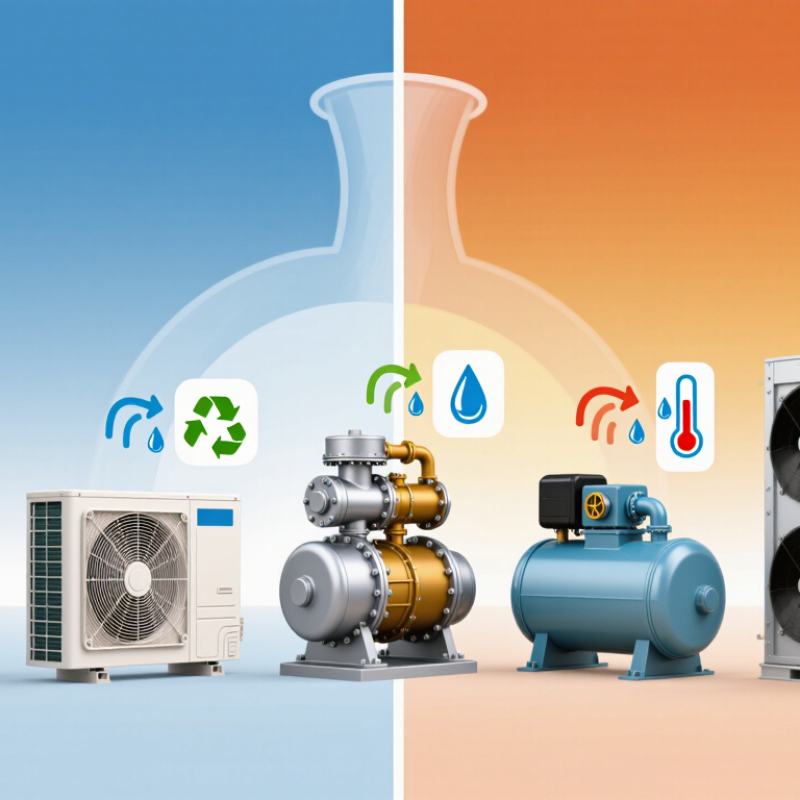
Capacity selection should begin with verified operating conditions, not a catalog headline. AHRI Standard 540-2020 defines rating procedures for positive-displacement refrigerant compressors and condensing units. Its published capacity and power values use controlled test conditions, including suction and discharge temperatures. Field performance can change sharply when a coil is dirty, ambient temperature rises, or suction lines run too long.
ASHRAE 90.1-2022 adds an efficiency screen for building systems. Buyers should compare rated capacity, input power, COP, EER, or IEER where applicable, then check the edition adopted by the project authority.
A 10-ton unit is not automatically better than an 8-ton unit. Oversizing may increase cycling, humidity problems, and installation cost.
The U.S. Department of Energy’s 2020 Commercial Buildings Energy Consumption Survey reports that refrigeration accounts for about 5% of commercial building electricity use, making selection errors financially visible.
Tips: Build a load profile by hour. Record room temperature, product pull-down, ambient temperature, defrost heat, and door openings. Match the unit’s AHRI 540 rating point to expected conditions, then test a warmer ambient case.
I have seen buyers trust one rating line too much. That is a weakness worth admitting. A careful comparison should include seasonal efficiency, standby controls, service access, and refrigerant restrictions.
Use the manufacturer’s certified data, but verify assumptions with a qualified engineer and the locally enforced ASHRAE 90.1 requirements.
Choosing a refrigeration condensing unit starts with the refrigerant. The environmental gap is substantial. CO₂ has a GWP of 1, while R-290 has a GWP of about 3. R-404A exceeds 3,900.
CO₂ systems suit buyers seeking very low climate impact and non-flammable refrigerant operation. However, they work at high pressures, demanding suitable valves, piping, controls, and trained technicians. Installation errors can become expensive quickly. R-290 offers excellent efficiency in many compact systems. Its flammability requires carefully controlled charge sizes, electrical protection, ventilation, and qualified servicing. It can be efficient, but it is not automatically simple.
R-404A remains familiar in older equipment, which may reduce short-term training costs. Its extremely high GWP creates stronger environmental and regulatory pressure. Replacement planning matters before a compressor fails during a busy season. Field assessments often show that ambient temperature changes, door openings, coil cleanliness, and maintenance quality affect performance more than buyers expect. A low GWP number is not the whole answer.
Compare cooling capacity at the real design temperature, not only catalogue conditions. Check local requirements, refrigerant availability, leak detection, spare parts, and technician skills. A small store may prefer R-290 for efficiency and compact equipment. A large industrial site may need CO₂ expertise and high-pressure infrastructure. R-404A can appear convenient, yet future service options may narrow. That uncomfortable detail deserves attention.
2026 Best Refrigeration Condensing Unit Types for Buyers
Buyer Matrix: Rank Efficiency, Noise, Climate Fit, Service, and 2026 Rules
In field inspections, air-cooled units usually win on installation simplicity and service access. They suit small shops, rooftop systems, and locations with limited water supplies. Their efficiency can fall during extreme heat. Keep clear airflow around the coil.
Water-cooled units often rank higher for steady efficiency and lower outdoor noise. They need reliable water treatment, pumps, and additional maintenance. They fit large facilities better than small retail rooms. Noise stays controlled.
For compressor selection, scroll systems offer smooth operation and fewer moving parts. Semi-hermetic systems can support deeper repairs, but technicians need stronger diagnostic skills. My practical ranking is efficiency first, climate fit second, service access third, noise fourth, and purchase cost last. That order changes in dense urban areas.
A useful buyer matrix should score each unit from one to five. Test noise near occupied rooms, not beside the condenser. Check capacity at the site’s real summer design temperature. Ask whether local technicians can source replacement controls. This is often overlooked.
The 2026 compliance picture requires careful verification. Confirm refrigerant restrictions, efficiency thresholds, labeling, leak procedures, and electrical requirements with local authorities. Rules differ by market. Do not trust an old specification sheet.
The matrix is imperfect. A highly efficient unit may become expensive when coils corrode or controls fail. Leave service clearance. Record operating pressures, temperatures, and power readings during commissioning. Those records make future decisions more reliable.
1272 Speers Rd Unit 4
Oakville ON Canada L6L 2X4
©Copyright 2020 Gosco Valves. All rights reserved.